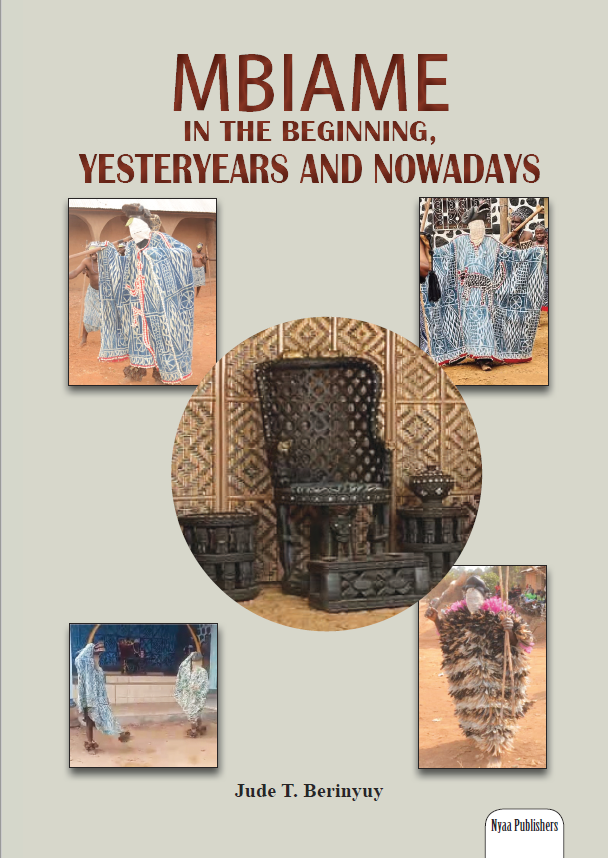
Mbiame History
About the Author:
Jude T. Berinyuy holds a PhD in Applied Linguistics. He is a permanent Lecturer of English Language, Linguistics and Creative Writing at the University of Bertoua, East Region of Cameroon. Berinyuy hails from Mbiame, Tanyar, where he served as a Roman Catholic catechist around the early 1990s. Financial instability forced him to attend several local primary schools, but he eventually obtained the FSLC in CS Kovki. His ambition of joining the priesthood was thwarted along the way. Berinyuy had the Ordinary Level in GSS Mbiame and the Advanced Level in GBHS Kumbo. At the University of Yaounde 1, he graduated with a First Degree in English and Literature, a Maitrise in English, obtained a Postgraduate Professional Teaching Diploma, Masters and finally the Terminal Degree in 2016. His critical and scientific publications include An Exploring Adventure into Advanced Level Drama (2014), Linguistic Rivalry and Prospects in Cameroon… (2017), Towards the Francophonisation of English in Cameroon (2018) and Should it be Name, Surname or What? (2021) among several others. Berinyuy is equally a contributor in An Anthology of Emerging Anglophone Poets (2010), author of two novels: The Return (2020) and Clash of Egos (2022) and a play, Johnny Just Come (2024). He is an actor and is married with four kids.
Book Category: History
Year of Publication: 2025
Number of Pages: 150
Book ISBN: 978-9956-30-736-4The book provides a detailed account of the history, geography, and cultural heritage of Mbiame Fondom, located in the Mbven subdivision of the North West Region of Cameroon. It highlights the Fondom’s administrative and traditional setup, its geographical boundaries, estimated population, and the socio-cultural activities of its people. Mbiame’s origins are traced to the Tikar ethnic group in Rifem, Bankim, with evidence supporting its ancestral ties to other Tikar-descendant tribes like the Nso, Oku, Bamoun, and Mbam. The migration history reveals that the people of Mbiame left Tikar due to population pressures, Fulani invasions, and disputes over leadership succession. The text dispels misconceptions about Mbiame's origins, emphasising that the Fondom was founded in 1392 by Fon Leh Mbijaame, independent of Nso or Oku. The text also details the cultural life of Mbiame, including farming, animal husbandry, hunting, and the vibrant Kpu Ye Wiyi Cultural Festival, which celebrates the community’s rich customs and traditions. This narrative is significant as it clarifies doubts about Mbiame's origins, reinforcing the shared historical and cultural bonds with neighbouring tribes while affirming its unique identity. It brings the history of Mbiame to life, offering contemporary Mbiame people and their neighbours a deeper understanding of their shared heritage.

